Skip to Content
FPD.DEV FPD.DEVThe Future of Display & Systems Development
  • Services
  • Products
  • Learning
  • Partners
  • Schedule Free Consultation
  • Sign in
  • 0
  • 0
FPD.DEV FPD.DEVThe Future of Display & Systems Development
  • 0
  • 0
    • Services
    • Products
    • Learning
    • Partners
  • Sign in
  • Schedule Free Consultation

← Learning: guides, tools and engineering shorts

Courses

Browse courses, find lessons and continue your learning.

Featured engineering courses

Explore NVIS Display Engineering and Optical Bonding Silicone. These are development editions; see each course for preview chapters and enrollment details.

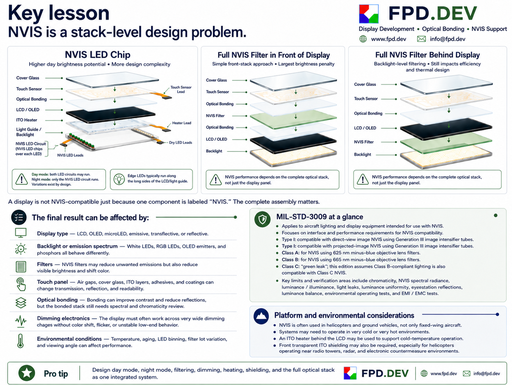
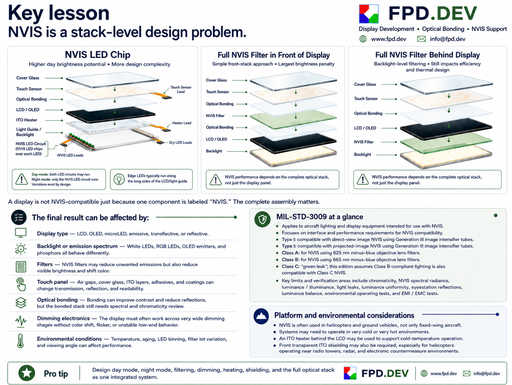
FPD.DEV diagram comparing NVIS display optical stacks
New · Development edition

NVIS Display Engineering — Spectra, Optics and Compatibility

Follow light from the backlight through the LCD, optical filters and front cover to the viewer and night-vision goggles. Explore MIL-STD-3009, spectral budgets, reflections, dimming, daylight contrast and practical measurement.

Chapter videos, reading pages, worked examples and follow-along PDFs connect the principles to display-engineering decisions. Explore the current chapters and course access details.

Explore NVIS Display Engineering →
Platinum Cure Optical Bonding Silicone for LCD Displays course
Free preview chapters About 12 hours including exercises

Platinum Cure Optical Bonding Silicone for LCD Displays

Connect LCD operation and polarizers to optical bonding, silicone chemistry, functional front covers, controlled manufacturing and display verification. Explore material selection, adhesion, cure control, bond mechanics and silicone enhancements.

Watch the introduction and preview Chapters 1–2. Further chapters and engineering resources are available through invitation enrollment. Includes narrated videos, chapter PDFs, worked calculations and a design capstone.

Explore Optical Bonding Silicone →

Published Courses

  • Certification icon Certifications
You do not have permission to access this course.

All Courses

NVIS Lighting, Displays and Goggles
Under development — free enrollment. Explore NVIS lighting, displays, goggles and the environment as one system across fixed-wing aircraft, helicopters and ground systems. Includes 12 core lessons, three spectral deep dives, interactive labs, a workbook, an assessment and printable PDF guides. Allow ten facilitated learning hours. Content may change as the course develops.

Enrollment is currently free; pricing may be introduced at release. Register and enroll while the course is free to retain access at no charge for at least three months after paid pricing begins. Learners who complete the course will retain access when pricing is introduced, beyond that three-month minimum.

Use the course forum to discuss content, ask questions and suggest improvements. Teaching examples do not establish equipment compliance or operator qualification.
10h 23 steps
DO-160 Display Qualification: Components, Systems and Installation

Free during development — limited-time access. Preview the full course free without enrollment while it is being developed. The end date is to be determined. Lessons 00–04 remain free public chapters for readers arriving from articles, including after the wider course moves to paid access. Sign in and enroll free to track your progress and record quiz completion.

Help improve the course. Use the course Forum to ask questions, discuss fixed-wing and helicopter display qualification, and suggest corrections. This is a development edition; lessons may be revised as the course grows.

Learn to plan and evaluate DO-160 environmental qualification for aircraft display components, complete display systems, and installed displays. Work through all 23 environmental sections, 11 original graphs and explanatory diagrams, 21 editable lesson tables, display-specific acceptance criteria, contractual requirements, and a practical qualification-plan capstone. All 25 course items are currently enabled for public preview. Scope: the display, its electronics, optics, enclosure, power and interfaces; remote sensors and radar equipment are outside this course. Development edition A-P02 — educational material, not a substitute for the applicable standards or an approved qualification plan.

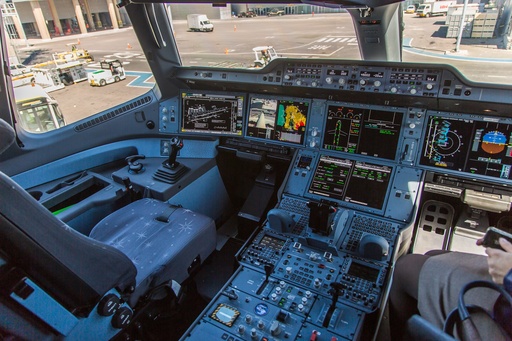
Cover photograph: Airbus A350 cockpit by Joao Carlos Medau, CC BY 2.0. Displayed at reduced size; the course card may crop the view.


12h 15m 25 steps
Platinum Cure Optical Bonding Silicone for LCD Displays
New Content
Platinum Cure Optical Bonding Silicone for LCD Displays

Optical Bonding of LCD Displays

Optical Bonding Displays with Platinum Cured Silicones

A detailed engineering course connecting LCD operation and polarizers to functional front covers, compliant silicone bonds, controlled manufacturing and verified display performance. Learn how platinum catalyst, crosslinkers, adhesion promoters, primers and retarders affect the bonding system.

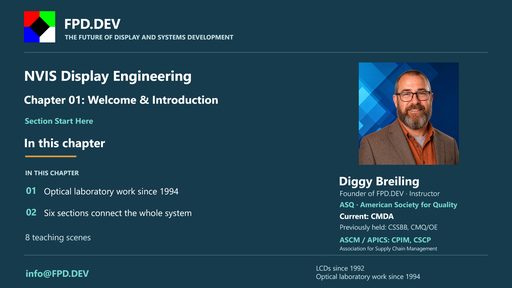
Watch the 2:42 introduction with Diggy Breiling, then preview Chapters 1 and 2 free. Invitation enrollment provides access to Chapters 3–17 and the engineering resources. No prior silicone chemistry is required.

Six course sections

  1. Foundations — Introduction and Chapters 1–2: why silicone; LCD image formation, color filtering, PVA/TAC polarizers, optical films and emissive-display comparisons.
  2. Core Engineering — Chapters 3–7: silicone chemistry; front covers, touch, ITO heaters, shields, mesh, masks and NVIS optical paths; optical performance; bond mechanics; material selection.
  3. Manufacturing — Chapters 8–10: surface adhesion and preparation lifetime; cure timing; humidity and temperature control; level, untwisted, thickness-controlled assembly.
  4. System Integration — Chapters 11–12: extended-temperature operation, installation loads, adhesive/cohesive failure analysis and complete-assembly verification.
  5. Silicone Enhancements — Chapters 13–17: catalyst, crosslinkers, adhesion promoters and primers, retarders and the design capstone. Includes product-specific primer windows and perimeter adhesion.
  6. Engineering Resources: calculations, exercises, references and glossary.

Chapter 2 provides the LCD foundation. Chapter 4 · front covers, touch panels, heaters and shields develops the functional cover; detailed chapters provide linked explanations of optics, forces, surface preparation and qualification.

Designed for display, optical, mechanical, process and quality engineers. Estimated study time: approximately 12 hours including exercises and reference reading, pending learner-pilot validation. Includes worked calculations, self-checks and a design capstone.

Related FPD.DEV courses

  • Display Optical Testing: Contrast, Reflection & Ambient Performance — Measurement geometry, contrast, reflection, uncertainty and laboratory reporting.
  • Optical Oracle™: Optical Enhancements & Sunlight Viewability — Optical enhancement comparisons and sunlight-viewability modeling.
  • DO-160 Display Qualification: Components, Systems and Installation — Environmental qualification planning for the complete installed display.

These are separate learning paths; follow each course’s current access and development-edition notices. They do not establish product qualification.

Suggested future specialist courses

Display Polarization and Backlight Engineering; Functional Cover Design: Touch, Heaters and EMI; and Silicone Adhesion Process Qualification. These are proposed topics, not available course offerings.

12h 13m 20 steps
NVIS Display Engineering — Spectra, Optics and Compatibility
New Content
NVIS Display Engineering — Spectra, Optics and Compatibility

Explore NVIS display engineering through 24 chapters on spectra, standards, optical stacks, reflection control, dimming and measurement.

Sign in to continue.

Use Back and Forward beneath the video to browse reading pages without interrupting playback. Follow along with the Chapter PDF, Glossary and references.

Discussion

General NVIS questions and feedback · Learner discussion

Chapters

  1. Welcome & Introduction
  2. The display and the two viewing tasks
  3. From MIL-L-85762A to MIL-STD-3009
  4. Types classes colors and the requirement boundary
  5. Night-Vision Technologies: What Each System Sees
  6. How image-intensifier goggles work
  7. The display in the shared lighting environment
  8. Reading spectra and keeping units consistent
  9. Measuring NVIS weighted radiance
  10. LEDs and the origin of their spectra
  11. RGB versus white backlights
  12. The LCD stack and the spectral budget
  13. Follow the light from backlight to viewer
  14. Absorbing interference and hybrid filters
  15. Filters in front of and behind the display
  16. Filters over LEDs and backlight rails
  17. Leakage and equal-output comparisons
  18. Dimming ratio and low-level control
  19. Daylight contrast and the brightness budget
  20. Modes transitions and fault behavior
  21. A practical measurement and verification program
  22. Product cases and architecture selection
  23. Workbook and facilitated laboratories
  24. Assessment and answer key

Development edition. Videos are available for Chapters 1–3; later chapters currently provide reading pages and follow-along PDFs.

37m 33 steps
Display Optical Testing: Contrast, Reflection & Ambient Performance

Under development — free early access. This course is open for learning and feedback while content is being developed. Enrollment is currently free and may remain free until formal release. A release date and future price have not yet been set.

  • Register and join the course: learners enrolled before paid pricing starts retain access without an additional course fee for at least three months from that effective date.
  • Complete the course and keep access: completed learners will not lose access because paid pricing is introduced, including early enrollees who complete during their protected access period.

Use the same account to record enrollment and completion. Future pricing and its effective date will be announced here before they take effect. There is no scheduled access cutoff at present. Discuss questions, corrections and suggestions in the course forum.

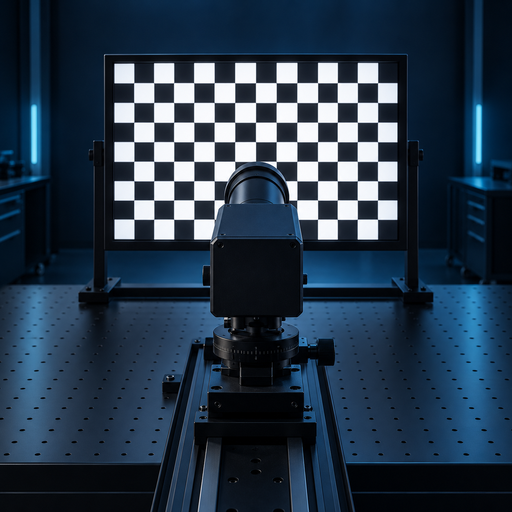
For display engineers and test technicians: contrast, luminance/color uniformity, viewing-angle tests in 15° increments, BRDF, specular and diffuse reflection, and combined ambient measurements. Includes manual setups, Pixel Perfect patterns, measurement lights, integrating spheres, goniometers, equipment images and links, specification comparisons, laboratory exercises and a 12-question knowledge check.

Estimated learning and laboratory time: 9 hours 30 minutes. A-P06 — Public development edition; final release pending.

9h 30m 15 steps
Optical Oracle™: Optical Enhancements & Sunlight Viewability
UNDER DEVELOPMENT — CURRENTLY FREE. This course is open for early access and feedback. Lessons and examples may change. It may remain free until formal release; release pricing has not been announced. Use the course forum to discuss content, ask questions and suggest improvements.

YOUR ACCESS AFTER RELEASE: Learners who register and enroll before release pricing begins will retain access for at least three months after pricing begins. Learners who complete the course will retain access when pricing takes effect; introducing pricing will not remove their course access.

Learn to use Optical Oracle™ to compare optical enhancements for sunlight viewability. Begin with a bare display and AR film, then explore cover glass, touch sensors, optical bonding, exterior AR, oleophobic/hydrophobic coatings, contamination and wear. Eight lessons and 32 scenarios serve applications engineers, sales engineers and customers, with eight retained OpticalOracle 3.0 worked comparisons, fresh live 3.0 screenshots and a new air-gap versus HEA-bonded quick comparison. Open the tool for every exercise at https://www.fpd.dev/opticaloracle — no key or sign-in is required. Includes an illustrated learning roadmap, FPD.DEV HACR comparison illustration, comparison workflow, downloadable reference PDFs, a workbook, knowledge check and capstone. Approximately 5 hours 10 minutes of core instruction plus optional labs. NVIS is a brief day/night coexistence introduction; detailed NVIS engineering and qualification belong in a separate course. A-P06 — Development preview / Not formally released. Model estimates and appearance previews do not establish measured product performance or NVIS compatibility.
5h 10m 14 steps
Optimizing Display Viewability: High-Performance Solutions for Challenging Environments


5m 1 steps
Material Handling Tips (SD)
1 steps
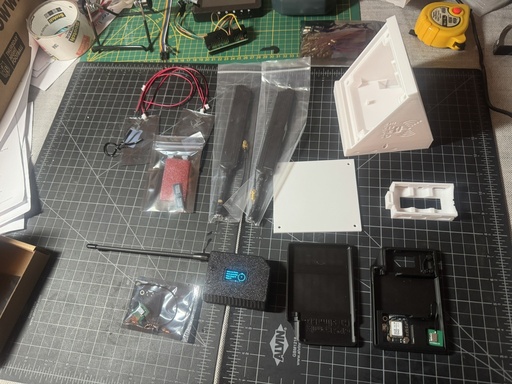
Meshtastic Venice Share
Meshtastic Introduction 
1 steps

Overview

Filters
Clear Filters

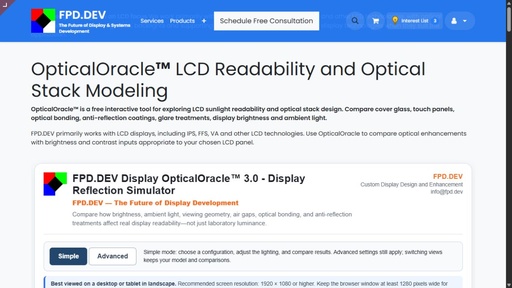
Display engineering with an LCD focus We work primarily with LCD displays, including IPS, FFS, VA and other LCD technologies, with optical enhancements, touch integration, backlights and supporting electronics. We also evaluate other display technologies when they suit the application.

Explore LCD optics with OpticalOracle™

Subscribe to the FPD.DEV newsletter

Get display and embedded engineering articles, Edge AI insights, tool updates and product news by email.

Thanks for registering!

Subscribe

By subscribing, you agree to receive the FPD.DEV newsletter. You can unsubscribe at any time. See our Privacy Policy.


FPD.DEV
The Future of Display & Systems Development

  • Contact Us


  • Privacy Policy


Get in touch

Operated by Colabmo · Quality, operations & ERP support.


Cookie Policy

Copyright © 2026 Colabmo ​ ​
English (US) Español
Powered by Colabmo
Powered by Colabmo

Essential cookies support website functions. With your permission, Google Analytics measures visits and Microsoft Clarity records masked interactions, heatmaps and session replays on approved public pages. Optional embedded features may also contact their providers. These providers receive usage and device data; Microsoft may use data for its own purposes, including advertising. You can reject optional services and change your choice later. Cookie PolicyPrivacy Policy

Allow all optional cookies Only essential cookiesManage choices