Optical Bonding and Lamination
Join rigid display surfaces or laminate flexible optical layers. We help select materials and develop the process for cover glass, touch panels, polarizers, anti-reflection films and conductive layers—from optical-stack review to production transfer.
MATERIALS AND METHODS
Different processes for different needs.
We distinguish the routes by the surfaces being joined: optical bonding joins two rigid surfaces, such as an LCD assembly and cover glass; optical lamination joins layers with at least one flexible surface, such as a film applied to glass or another film.
OPTICAL BONDING · LIQUID
Liquid silicone gel
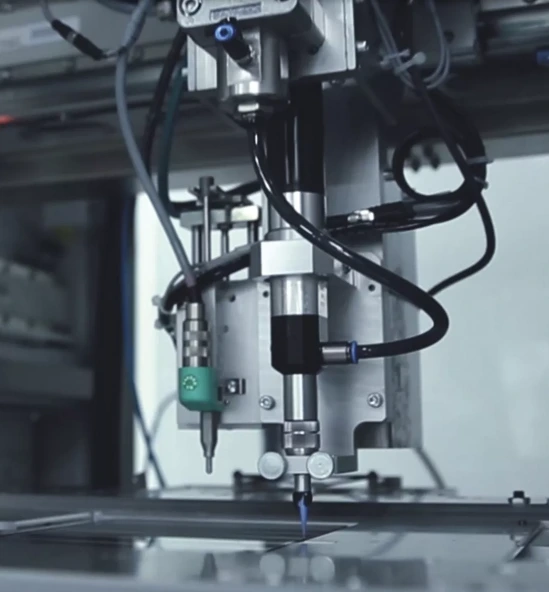
Optically clear liquid silicone is dispensed or filled between two rigid optical surfaces, then cured to form a compliant coupling layer.
A useful route for tailored bondline thickness and assembly geometry. Material preparation, flow, bubble control, alignment and cure are developed together.
OPTICAL BONDING · DRY
Cured silicone sheet
A pre-cured, optically clear silicone sheet is placed between the display and cover or touch panel, then bonded using controlled vacuum and pressure.
Sheet thickness, surface conformity, trapped-air removal and applied pressure are matched to the stack. This route uses a pre-cured coupling material.
OPTICAL FILM LAMINATION
Flexible films with PSA
Optical lamination uses an optically clear pressure-sensitive adhesive (PSA) to attach a flexible film, such as a polarizer or an anti-reflection film on a PET sheet.
Examples include polarizers, suitable DBEF reflective-polarizer grades, anti-reflection films on PET, EMI mesh and ITO films on flexible substrates. Match the adhesive and process to the specific film construction.
Select the route around substrate rigidity, coating compatibility, bondline thickness, optical performance, mechanical stress and production volume. The material and process are selected as a system.
OPTICAL LAMINATION · AT LEAST ONE FLEXIBLE LAYER
Apply the film without losing its function.
Optically clear PSA joins a flexible optical layer to a rigid surface or another flexible layer. Cleaning, alignment, controlled pressure and air removal are developed around the adhesive and the film.
Polarizers, reflective films and AR films
- Polarizers: align the polarization axis and select adhesive compatibility with the display surface.
- Some DBEF films: evaluate the exact reflective-polarizer grade and its intended lamination construction.
- Anti-reflection films on PET: laminate the adhesive side while retaining the treated outer surface.
Some backlight films rely on air interfaces or structured surfaces. Confirm the film is intended for lamination before applying adhesive across its optical area.
EMI mesh and conductive films
- EMI mesh: review visibility, moiré, encapsulation and the electrical connection around the window.
- ITO on flexible substrates: select transmission, sheet resistance, adhesive compatibility and contact locations.
Keep required bus bars, grounding contacts or heater connections accessible. Optical appearance and electrical continuity are verified on the completed stack.
Inspection can include bubbles, particles, haze, alignment, adhesion and environmental durability. PSA lamination and silicone curing use different process controls; the silicone set and cure ranges below apply to the liquid-silicone route.
Explore optical films and coatings · Review reflective polarizers · Explore EMI shielding
PLATINUM-CURE OPTICAL SILICONES
Match the cure to your workflow.
We support cure customization for platinum-cure optical silicones, balancing time for mixing, dispensing and alignment with the required production schedule.
Discuss set-time targets from 3 minutes to 2 hours and cure-time targets from 15 minutes to 24+ hours. These are formulation and process-development ranges; the achievable combination depends on the selected silicone, temperature, substrates and assembly.
Balanced for a 1:1 mix
We can reformulate liquid platinum-cure optical silicones supplied at unequal component ratios into a balanced 1:1 A/B mixing system. Formulation development defines whether the ratio is by weight or volume and verifies the required cure, optical and mechanical properties.
Working time, set or handling time, and full cure are defined separately. We establish the permitted handling point and confirm full cure for the required properties, including compatibility with coatings and potential cure inhibition.
Tell us what the process needs to do.
- Time needed for preparation, application and alignment.
- When the assembly must be handled, inspected or tested.
- Allowable temperature and substrate sensitivity.
- Bondline thickness, optical targets and production volume.
Where we can help
Optical bonding and lamination projects involve more than choosing an adhesive. Cover glass, touch panels, display surfaces, mechanical clearances, cleaning, dispensing, curing, and inspection all need to work together. We help teams evaluate these requirements for a new assembly, an existing process with yield problems, or a planned move to in-house production.
- Review the display, cover glass, touch panel, and optical stack requirements.
- Evaluate bonding materials, supplier options, handling methods, and process risks.
- Develop tooling and fixture concepts, process steps, and inspection criteria.
- Support low-volume process setup, production troubleshooting, or automation planning.
Typical project outputs
Depending on the agreed scope, outputs may include a design-for-bonding review, material evaluation plan, tooling concepts, process instructions, inspection criteria, or a supplier qualification checklist. We define the required outputs and acceptance criteria with you before work begins.
What to include in your inquiry
- Display and cover dimensions, drawings, and available component specifications.
- Optical, touch, temperature, moisture, and mechanical requirements.
- Target volume, development stage, and whether bonding or lamination will be outsourced or performed in-house.
- Required working time, handling point, cure schedule and allowable process temperature.
- Existing process information, sample defects, and relevant evaluation results.
FROM DEVELOPMENT TO PRODUCTION
Experience that connects your process to the right production partner.
Companies that have engaged us to develop in-house optical bonding processes include Planar, Spectrum Display, Litemax (Taiwan), A&E (South Korea), Interactive Display Solutions and Via Optronic, among others.
We draw on that hands-on experience and our understanding of each company’s strengths to guide you toward a production partner suited to your specific materials, process, volume and application.
We can reconnect with these companies as a program moves toward production, support the process transfer and help resolve issues when results depart from expectations.
Support through production
- Match process requirements to partner capabilities.
- Transfer material, tooling and process knowledge.
- Define acceptance criteria and production checks.
- Investigate defects and support corrective action.
Can you help establish an in-house bonding or lamination process?
Yes. Our support includes low-volume in-house process planning and higher-volume automation planning. The approach depends on the assembly, materials, required controls, available equipment, and production goals.
Related tools and products
- OpticalOracle reflection simulator
- Optical bonding materials
- Films and coatings for optical lamination
- LCD enhancement selection overview
- Display enhancement design consultation
Use these resources to prepare your requirements. Product suitability and evaluation results should be confirmed for the selected configuration and application.
Discuss your project
Tell us what you are developing or trying to resolve. We can help define the scope, required inputs, and next step. Pricing is provided by quotation.