Skip to Content
FPD.DEV FPD.DEVThe Future of Display & Systems Development
  • Services
  • Products
  • Learning
  • Partners
  • Videos
  • Schedule Free Consultation
  • Sign in
  • 0
  • 0
  • English (US)  Français  Deutsch  Español
FPD.DEV FPD.DEVThe Future of Display & Systems Development
  • 0
  • 0
    • Services
    • Products
    • Learning
    • Partners
    • Videos
  • English (US)  Français  Deutsch  Español
  • Sign in
  • Schedule Free Consultation
  1. Courses
  2. CIE 1931 and 1976 Chromaticity Charts — Color, Transformations and NVIS
Nav
Home └CIE 1931 and 1976 Chromaticity Charts — Color, Transformations and NVIS
CIE 1931 and 1976 Chromaticity Charts — Color, Transformations and NVIS

CIE 1931 and 1976 Chromaticity Charts — Color, Transformations and NVIS

Start here: Watch Chapter 1

Why color needed coordinates — preview the first chapter, then follow along with its reading and optional slide deck.

Open Chapter 1 and follow along

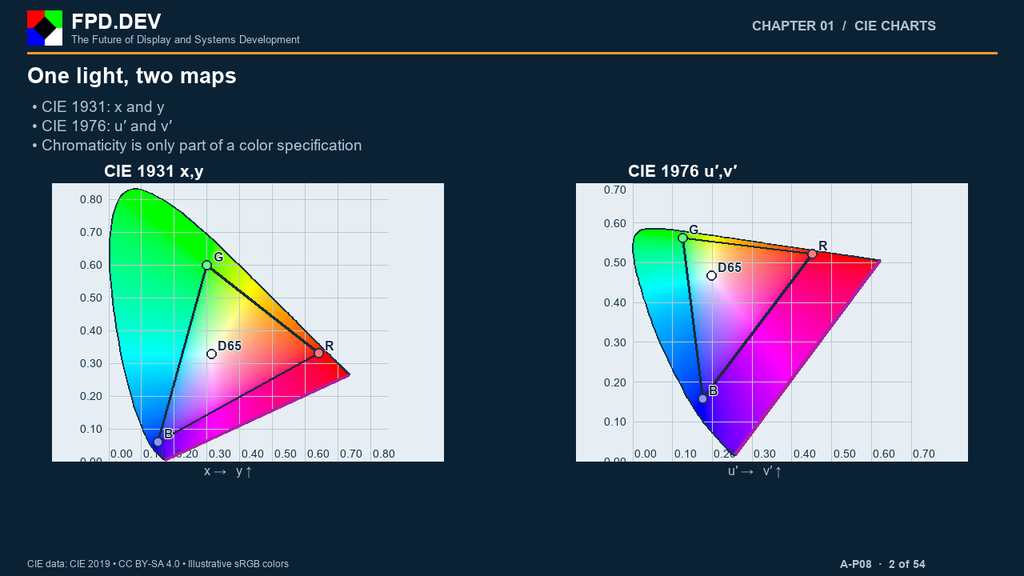
Learn to read CIE 1931 xy and CIE 1976 u′v′ charts, understand their history, and transform the same colors and boundaries between them. Nine chapter videos provide approximately 22 minutes of animation across 54 slides, with worked examples, chapter PDFs, a full master deck, a glossary, and guided practice with the FPD.DEV CIE Calculator.

Preview chapters 1–3 without logging in. Sign in to continue with chapters 4–9. Each chapter has a separate, collapsed extra slide deck and a visible Chapter Reading section.

Explore the spectral locus and line of purples; physical, display-gamut and specification limits; mixing and white points; tolerance geometry; and an OLED/NVIS engineering case study. Chapter 8 introduces FPD.DEV PN OLD-030015-00, a 128 × 64 monochrome green OLED, as one product example. Other monochrome OLEDs can be evaluated with their own chromaticity and tolerances.

Explore filter design directly beneath Chapter 8’s reading: compare the unfiltered point and modeled tolerance region, first containment, added margin, and luminance loss. Chromaticity acceptance and NVIS spectral compatibility are assessed separately. Allow 60–90 minutes with readings and exercises.

Development edition A-P08 / Draft / Not Released. Product specifications and filter examples are preliminary; modeled results do not establish physical qualification.

Join this Course
Responsible Colabmo, Diggy Breiling.c
Last Update 11/01/2026
Completion Time 22 minutes
Members 1
  • Course
  • Reviews
  • CIE charts: theory and practice (empty)
    9Lessons · 22 min
    • 1. Why color needed coordinates
      Preview New
    • 2. Reading the 1931 chart and its limits
      Preview New
    • 3. Why CIE introduced 1976 u′v′
      Preview New
    • 4. Transforming points and boundaries
      New
    • 5. Mixing, white points and display gamut
      New
    • 6. Tolerances and measurement decisions
      New
    • 7. Guided FPD.DEV calculator laboratory
      New
    • 8. NVIS engineering case study
      New
    • 9. Review and glossary
      New

Display engineering with an LCD focus We work primarily with LCD displays, including IPS, FFS, VA and other LCD technologies, with optical enhancements, touch integration, backlights and supporting electronics. We also evaluate other display technologies when they suit the application.

Explore LCD optics with OpticalOracle™

Subscribe to the FPD.DEV newsletter

Get display and embedded engineering articles, Edge AI insights, tool updates and product news by email.

Thanks for registering!

Subscribe

By subscribing, you agree to receive the FPD.DEV newsletter. You can unsubscribe at any time. See our Privacy Policy.


FPD.DEV
The Future of Display & Systems Development

  • Contact Us


  • Privacy Policy


Get in touch

Operated by Colabmo · Quality, operations & ERP support.


Cookie Policy

Copyright © 2026 Colabmo ​ ​
Powered by Colabmo
Powered by Colabmo

Essential cookies support website functions. With your permission, Google Analytics measures visits and Microsoft Clarity records masked interactions, heatmaps and session replays on approved public pages. Optional embedded features may also contact their providers. These providers receive usage and device data; Microsoft may use data for its own purposes, including advertising. You can reject optional services and change your choice later. Cookie PolicyPrivacy Policy

Allow all optional cookies Only essential cookiesManage choices