FPD.DEV Engineering Shorts
Free display engineering courses, calculators, and tools for optical bonding, readability, and embedded systems.

High Ambient Contrast Ratio for Sunlight-Readable Displays
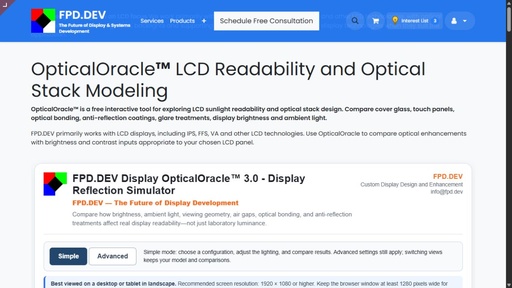
A free quick course on HACR, reflected ambient light, and practical display readability. Learn why brightness alone is not enough and how optical bonding, AR coatings, black level, and ambient illumination determine whether a display remains usable in bright environments.

HACR Display Readability Calculator
Estimate display readability in sunlight and bright environments. Compare brightness, black level, ambient light, reflection percentage, AR coatings, and optical bonding in one quick calculator.

OEM & Resized Display Test Pattern Generator
Create pixel-accurate LCD and OLED test patterns for both OEM stock panels and resized displays. OEM patterns match the full panel resolution, while resized-display patterns keep the original resolution and place the active test image only inside the resized area, with everything outside shown as black.

Re-Sized Display Pixel Calculator
Estimate the resolution, aspect ratio, diagonal size, and active area of a display after it has been physically cut or resized.
Enter the original panel resolution and active dimensions, then define the resized active area by width, height, or aspect ratio. The calculator estimates the new usable pixel resolution based on the original pixel pitch.

Modular Digital Signage Layout Calculator
Plan tiled LCD, OLED, LED, and specialty display arrays by combining individual display modules into one larger image area.
Use this calculator to estimate display size, resolution, pixel density, module count, active image area, and module layout. Remove modules from the grid to model shaped signs, stepped displays, cut-outs, and other custom configurations.
Cursos

Todos los cursos
Free during development — limited-time access. Preview the full course free without enrollment while it is being developed. The end date is to be determined. Lessons 00–04 remain free public chapters for readers arriving from articles, including after the wider course moves to paid access. Sign in and enroll free to track your progress and record quiz completion.
Help improve the course. Use the course Forum to ask questions, discuss fixed-wing and helicopter display qualification, and suggest corrections. This is a development edition; lessons may be revised as the course grows.
Learn to plan and evaluate DO-160 environmental qualification for aircraft display components, complete display systems, and installed displays. Work through all 23 environmental sections, 11 original graphs and explanatory diagrams, 21 editable lesson tables, display-specific acceptance criteria, contractual requirements, and a practical qualification-plan capstone. All 25 course items are currently enabled for public preview. Scope: the display, its electronics, optics, enclosure, power and interfaces; remote sensors and radar equipment are outside this course. Development edition A-P02 — educational material, not a substitute for the applicable standards or an approved qualification plan.
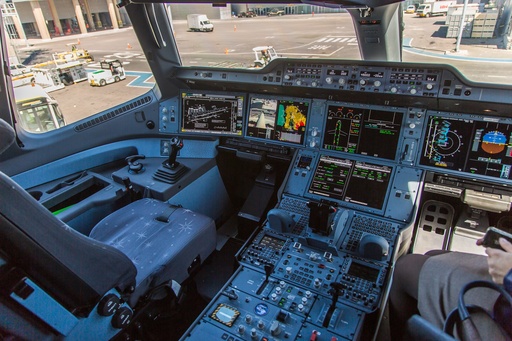
Cover photograph: Airbus A350 cockpit by Joao Carlos Medau, CC BY 2.0. Displayed at reduced size; the course card may crop the view.
Under development — free early access. This course is open for learning and feedback while content is being developed. Enrollment is currently free and may remain free until formal release. A release date and future price have not yet been set.
- Register and join the course: learners enrolled before paid pricing starts retain access without an additional course fee for at least three months from that effective date.
- Complete the course and keep access: completed learners will not lose access because paid pricing is introduced, including early enrollees who complete during their protected access period.
Use the same account to record enrollment and completion. Future pricing and its effective date will be announced here before they take effect. There is no scheduled access cutoff at present. Discuss questions, corrections and suggestions in the course forum.
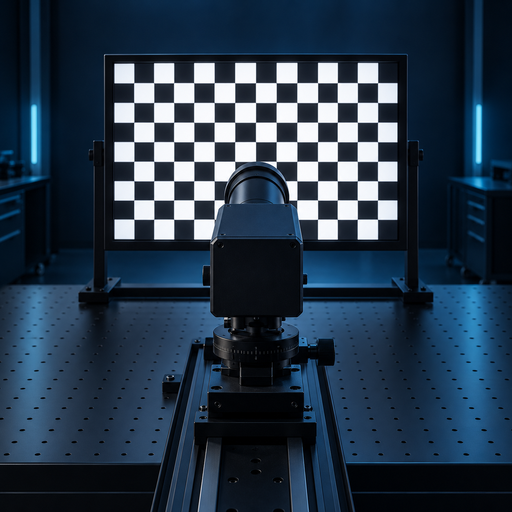
For display engineers and test technicians: contrast, luminance/color uniformity, viewing-angle tests in 15° increments, BRDF, specular and diffuse reflection, and combined ambient measurements. Includes manual setups, Pixel Perfect patterns, measurement lights, integrating spheres, goniometers, equipment images and links, specification comparisons, laboratory exercises and a 12-question knowledge check.
Estimated learning and laboratory time: 9 hours 30 minutes. A-P06 — Public development edition; final release pending.